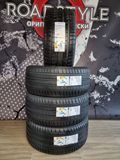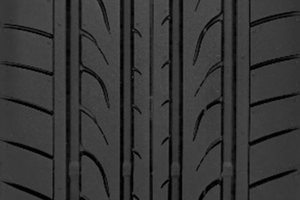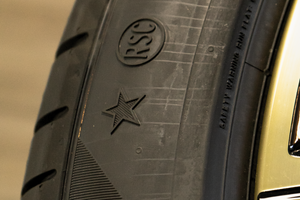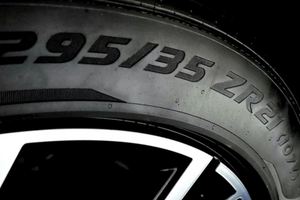

Let's start with the UTQG classification - Uniform Trade Quality Grade - a system of 3 parameters to facilitate the selection of the right rubber. Introduced by the US Department of Transportation (DOT)
▪️TREADWEAR - Wear resistance index. This parameter shows the degree of tire mileage, the higher the index - the greater the mileage the tire will have. Based on DOT indicators - a reference tire with Treadwear 100 has a mileage of 48 thousand km. Accordingly, a tire with an index of 200 can travel twice as much - 96 thousand km. In real conditions, the mileage of the tire is less, but the overall proportion is preserved.
▪️TRACTION - Grip index, shows the level of grip on wet roads. It has a gradation from AA to C, where AA is the maximum level of grip, and C is the opposite.
In everyday life, the "A" marking is quite sufficient. As a rule, sports tires have the "AA" marking. They have a high level of grip, but low wear resistance. Although today there are rubber options where these two parameters are at a high level.
▪️TEMPERATURE – Temperature index, characterizes the ability of the tire to withstand temperature loads at speed. Here they use a scale from "A" to "C", where "A" - the ability to withstand temperatures of more than 184 km/h, "B" - from 160 to 184 km/h, "C" - from 136 to 160 km/h.
Further classification by type of car:
— P(PASSENGER) - for passenger cars.
— SUV( SPORT UTILITY VEHICLE) - crossovers and off-road vehicles.
— C(COMMERCIAL) - the letter after the tire diameter ( R15C) - for minibuses and light trucks.
— LPT (LOW PLATFORM TRAILER) - tires for trailers.
Classification by sealing method:
— TUBELESS (TL) - tubeless tire
— TUBE TYPE (TT) - tube tire
🚩So, we have sorted out the first part of the auxiliary marking. Keep it and use it, and we will be happy to help you choose the right set of tires 😉